
Heroes of Barcadia: How the Game Really Works
If you are searching for Heroes of Barcadia, you are probably trying to answer a simple question: is this actually a good board game, or is it just a novelty drinking game with fantasy artwork? The answer depends heavily on what you expect from it.
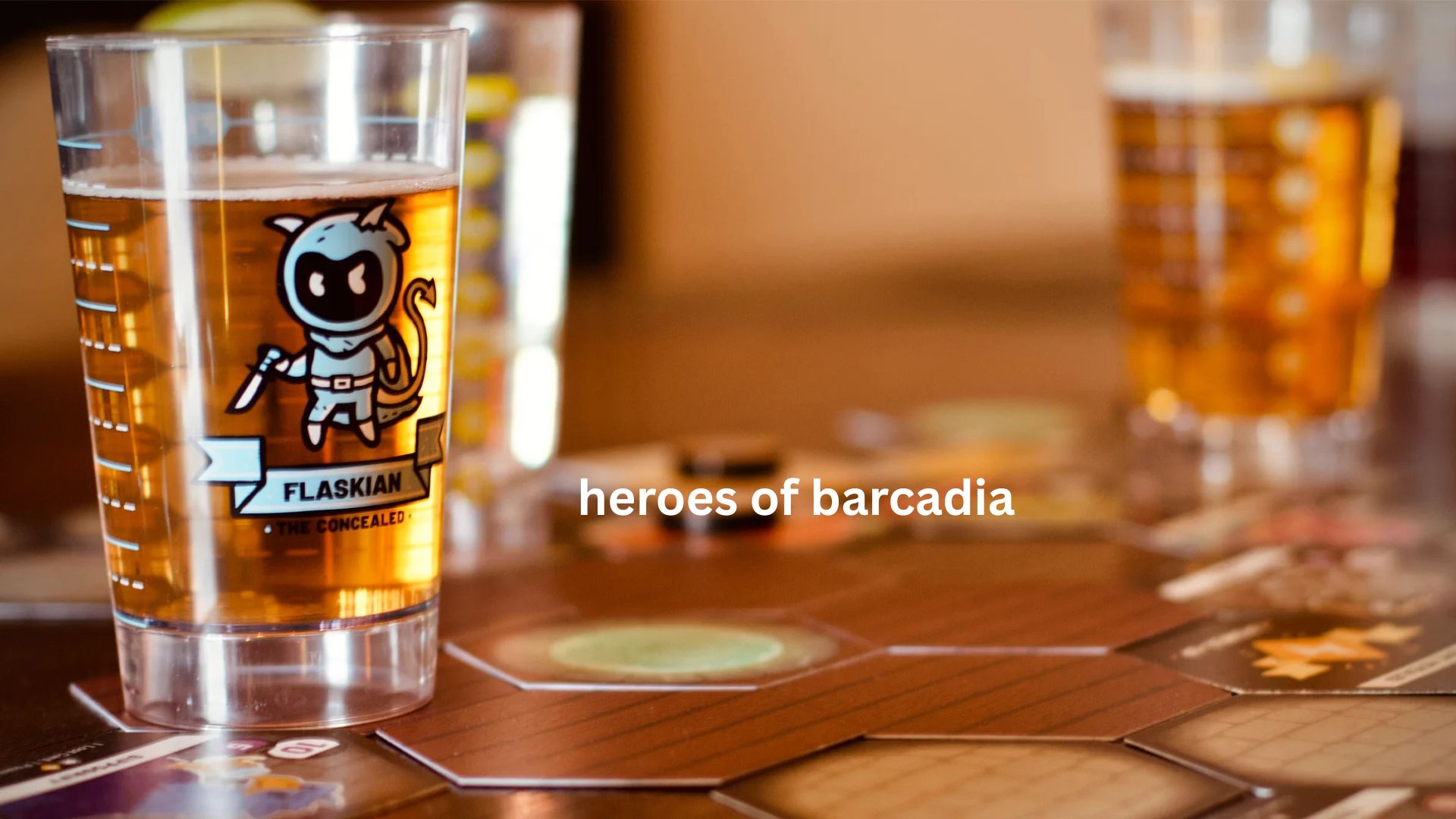
Heroes of Barcadia is a competitive dungeon-crawling party game from Rollacrit that combines tile exploration, dice-based combat, take-that cards, and an unusual health system: your character’s health is represented by the amount of liquid in your character cup. The base game supports 2–6 players, while the Party Pack can raise the table to eight.
What makes the game interesting is not deep tactical combat. Instead, it creates a constantly changing race in which players explore an unknown dungeon, collect Power-Ups, interfere with opponents, and eventually try to defeat the monster protecting the Drink Hoard. That makes it especially effective when the goal is laughter, interaction, and an easy-to-teach group game rather than a highly strategic dungeon crawler.
What Is Heroes of Barcadia?
Heroes of Barcadia is a 2–6 player competitive dungeon-crawling tabletop party game in which players explore a randomly constructed dungeon while using drinks as their health meters.
The basic premise is deliberately silly. Monsters have stolen Barcadia’s drinks, and the players take on the role of heroes trying to recover the Drink Hoard.
The game was designed by Madison O’Neil and published by Rollacrit. Its original Kickstarter campaign raised more than $1.25 million from 13,772 backers, substantially exceeding its $50,000 goal.
That Kickstarter success is useful context because it explains what the game is designed to accomplish. It was not created as a heavyweight strategy game competing with complex dungeon crawlers. Its strength is the combination of:
- Fantasy dungeon exploration
- Party-game interaction
- Dice-based combat
- Randomized exploration
- Player-versus-player interference
- Drink-based health
- Humorous fantasy and beverage-themed characters
In other words, the game is closer to a social dungeon crawl than a traditional role-playing campaign.
How Heroes of Barcadia Works
The easiest way to understand the game is to follow a typical round.
1. Build the dungeon
Players begin with a starting area and gradually construct the dungeon using hexagonal room tiles.
The tiles are placed face down, which means players do not know exactly what they will discover. Because the dungeon is assembled differently from game to game, the route toward the final objective can change considerably.
This is one of the game’s most effective ideas.
You are not simply moving around a board that everyone already understands. You are making decisions with incomplete information.
2. Choose a hero
Players select their characters and receive the corresponding character components and cup.
The important point for newcomers is that choosing a character is not the same as selecting a complicated RPG class. The heroes are primarily part of the game’s personality and presentation rather than deeply asymmetric strategic roles.
That makes character selection quick, which is useful when introducing the game to people who do not normally play board games.
3. Your drink becomes your health
This is the game’s defining mechanic.
Instead of tracking health with counters, a character’s drink level represents their remaining health. The official FAQ specifically notes that the game does not require alcohol; players can use whatever beverage they choose.
That distinction matters.
Calling Heroes of Barcadia a “drinking game” can make it sound as though consuming alcohol is mandatory. It is not. The underlying mechanic is really a liquid health meter.
That means the game can work with:
- Water
- Soda
- Juice
- Mocktails
- Other non-alcoholic drinks
- Alcoholic beverages for adults who choose to drink
The safest way to approach the mechanic is to treat the drink as a game component rather than as a challenge to consume a certain amount.
Exploring the Dungeon
On your turn, you generally move through adjacent tiles and reveal unexplored rooms.
What you find may provide rewards, Power-Ups, monsters, traps, or other effects.
The interesting part is that exploration creates information that everyone can use.
Suppose another player discovers a dangerous monster and fails to defeat it. The tile can become relevant again later. If you remember where dangerous locations are, you can sometimes make better movement decisions than someone who was not paying attention.
This creates a small but surprisingly useful memory element.
A practical example
Imagine that three turns earlier you saw an opponent fail against a monster in a particular area.
Later, another player is moving toward that region.
You may not need to attack them directly. Simply knowing that the area contains a problem can influence where you move and which route you take.
That is one of the less obvious strategic layers of Heroes of Barcadia: information has value even when you cannot directly control the dungeon.
How Combat Works
Combat is deliberately simple.
When you encounter a monster, the game uses dice and modifiers to determine the outcome. Other players can become involved, depending on the rules and cards available.
The result is much faster than combat in a traditional dungeon-crawler.
If you enjoy games with detailed character builds, equipment systems, tactical positioning, and lengthy combat rounds, Heroes of Barcadia may feel too light.
If your group dislikes spending ten minutes resolving one monster encounter, that simplicity becomes an advantage.
The game essentially asks:
Can you take this risk right now, and what will the other players do about it?
That question is more important than building a perfect character.
Power-Ups Are More Important Than They Look
One of the most important objectives is collecting Power-Ups.
You need three Power-Ups before you can attempt to defeat the monster guarding the Drink Hoard.
At first, it can be tempting to think of Power-Ups simply as progression.
That is a mistake.
Power-Ups are also a signal to the table.
If another player is accumulating them quickly, everyone knows that person is moving closer to the endgame. That can change the way the entire group behaves.
The player in first place becomes a target.
This is where the game’s social strategy becomes more important than its mathematical strategy.
Loot Cards and Player Interaction
Heroes of Barcadia becomes much more interesting when players start using their cards against each other.
Cards can influence encounters, movement, traps, and other players’ progress. Reviews have highlighted this “take-that” element as one of the game’s main sources of interaction.
For example, a player who appears comfortably ahead might suddenly find another player placing an obstacle in their path or modifying the situation around an encounter.
This produces a useful balancing effect:
Being ahead does not necessarily mean being safe.
That is important in a party game because it gives players who fall behind a reason to remain engaged.
The Endgame Is Where the Game Changes
The early and middle portions of Heroes of Barcadia are largely about exploration and preparation.
The final stage is different.
Once the Drink Hoard is found, the game becomes a race.
The player who reaches the required Power-Up threshold and successfully defeats the final guardian can win. Other players can interfere, making the final portion much more chaotic than the opening exploration.
This creates an important practical lesson:
Do not assume the player who finds the objective first has already won.
The discovery of the Drink Hoard effectively announces to everyone:
“The game is now ending.”
That information changes everyone’s priorities.
Players who were previously exploring for themselves may suddenly focus entirely on stopping the leader.
Heroes of Barcadia vs. a Traditional Dungeon Crawler
| Heroes of Barcadia | Traditional dungeon crawler |
|---|---|
| Fast, social gameplay | Often longer and more strategic |
| Simple combat | More detailed combat systems |
| Random exploration | Often structured scenarios |
| Strong player interaction | Frequently cooperative |
| Light character development | Deeper character progression |
| Party-game atmosphere | Adventure/tactical atmosphere |
| Designed for laughs and chaos | Often designed around optimization |
The biggest difference is purpose.
A traditional dungeon crawler may ask:
How can our team defeat this scenario efficiently?
Heroes of Barcadia is more likely to ask:
How can I get ahead while everyone else is trying to stop me?
That makes the games difficult to compare purely on complexity.
Is Heroes of Barcadia Actually Strategic?
Yes, but only to a point.
It would be misleading to describe it as a deeply strategic board game.
Random tile placement, dice rolls, cards, and encounters have substantial influence over what happens. Some reviewers have specifically criticized the game’s limited strategic depth and randomness.
However, there is still meaningful decision-making.
You can choose:
- Which direction to explore
- When to take a risk
- When to conserve useful cards
- Which opponent to interfere with
- Whether to pursue the objective or investigate another area
- How aggressively to respond to another player’s lead
The strategy is therefore situational rather than analytical.
That distinction explains why experienced strategy gamers may find it shallow while casual groups can find it surprisingly entertaining.
Three Less-Obvious Insights About the Game
1. The health system changes social behavior
The drink cup is not merely a funny replacement for hit points.
Because health is physically visible, players can immediately see who is vulnerable and who is doing well.
That makes the game’s state easier to understand without constantly checking a player board.
2. Memory can matter more than expected
The dungeon’s face-down tiles create imperfect information.
Remembering where failed encounters, useful rooms, or important discoveries occurred can help you make better choices later.
It is a small mechanic, but it gives experienced players another way to gain an advantage without making the game complicated.
3. The leader is often psychologically disadvantaged
Once everyone notices that one player has accumulated Power-Ups, that player’s position becomes obvious.
In many competitive games, being ahead is purely positive.
Here, being ahead can attract unwanted attention.
A clever player may therefore avoid appearing too dominant until they are prepared to make a serious push toward the final objective.
Common Mistakes New Players Make
Treating every monster encounter as necessary
You do not always need to rush into every possible fight.
Think about the risk versus what you actually gain.
Ignoring other players
This is perhaps the biggest mistake.
Heroes of Barcadia is not a multiplayer solitaire dungeon crawler. Opponents can influence your progress, so watching what they collect and where they move matters.
Using useful cards too early
A powerful card can be tempting to play immediately.
Sometimes keeping it for the final race is more valuable.
Forgetting that the game is social
If your group approaches every dice roll as a serious competitive calculation, the game can feel underwhelming.
Its best experiences usually come when players embrace the chaos and interact with one another.
How Many People Should Play?
The base game supports 2–6 players, while the Party Pack can increase the maximum to eight.
In practical terms, player count changes the experience considerably.
Two players
The game becomes more directly competitive. There are fewer people creating distractions, so each player’s decisions have greater impact.
Three or four players
This is a good middle ground if your group wants interaction without too much table chaos.
Five or six players
The social element becomes stronger, and more unpredictable things can happen between turns.
Seven or eight players
The Party Pack supports larger groups, but expect a busier experience. More players can be excellent for a party, although people who prefer fast individual turns may find the downtime less appealing.
Who Should Play Heroes of Barcadia?
This game is a strong choice if you enjoy:
- Light fantasy themes
- Party board games
- Dice rolling
- Competitive interaction
- Dungeon exploration
- Silly humor
- Quick-to-learn rules
- Games where luck is part of the fun
It is less suitable if you want:
- Deep tactical combat
- Complex character development
- A cooperative campaign
- Highly deterministic strategy
- Minimal player interference
- A serious fantasy role-playing experience
The official game information describes it as a 2–6 player tile-based dungeon-crawling party game, while the optional Party Pack expands the player count to eight.
Heroes for Hire: Is the Expansion Worth Knowing About?
The Heroes of Barcadia: Heroes for Hire expansion adds new heroes, Power-Ups, and gameplay elements and requires the base game.
One notable addition is the Die of Barcane mechanic. After seven Loot Cards have been played, the die activates and introduces another layer of unpredictability.
The important point is that Heroes for Hire is not a replacement for the original game.
Think of it as additional material for groups that already understand and enjoy the base system.
FAQ
Is Heroes of Barcadia a drinking game?
It is commonly described as a drinking game, but alcohol is not required. The game’s health system uses liquid in the character cups, and the official FAQ says players can use whatever drink they prefer.
How many players can play Heroes of Barcadia?
The base game supports two to six players. With the Party Pack, the game can accommodate up to eight players while maintaining the same overall character-cup system.
Is Heroes of Barcadia good for people who do not play board games?
Yes, particularly if they enjoy party games. The core movement and combat systems are straightforward, so new players can generally understand the basic objective without learning a large rulebook first.
Is Heroes of Barcadia a cooperative game?
No. It is primarily competitive. Players explore the dungeon and pursue the Drink Hoard for themselves, while cards and other mechanics allow them to interfere with opponents.
Is Heroes of Barcadia suitable for a serious strategy gamer?
Probably not if deep strategy is your main priority. Dice, random tiles, cards, and unpredictable player interaction have a major influence on the outcome, so the game is better understood as a light competitive party experience than as a heavy strategy title.
Does Heroes for Hire require the original game?
Yes. The expansion is designed to integrate with the base Heroes of Barcadia game, so you need the original game to use Heroes for Hire.
Final Verdict
Heroes of Barcadia works best when you approach it as a social dungeon-crawling party game rather than a serious dungeon-crawler.
Its greatest strengths are accessibility, humor, physical interaction, unpredictable exploration, and the unusual drink-as-health mechanic. Its greatest weaknesses are randomness and relatively limited strategic depth.
The most important practical question is therefore not “Is it the deepest dungeon crawler?” It clearly is not.
The better question is:
Will your group enjoy exploring a ridiculous dungeon, sabotaging one another, rolling dice, and laughing when a promising plan falls apart?
If the answer is yes, Heroes of Barcadia has a very specific niche—and it fills that niche surprisingly well.