

Panel de Pon: The Puzzle Game That Rewards Speed
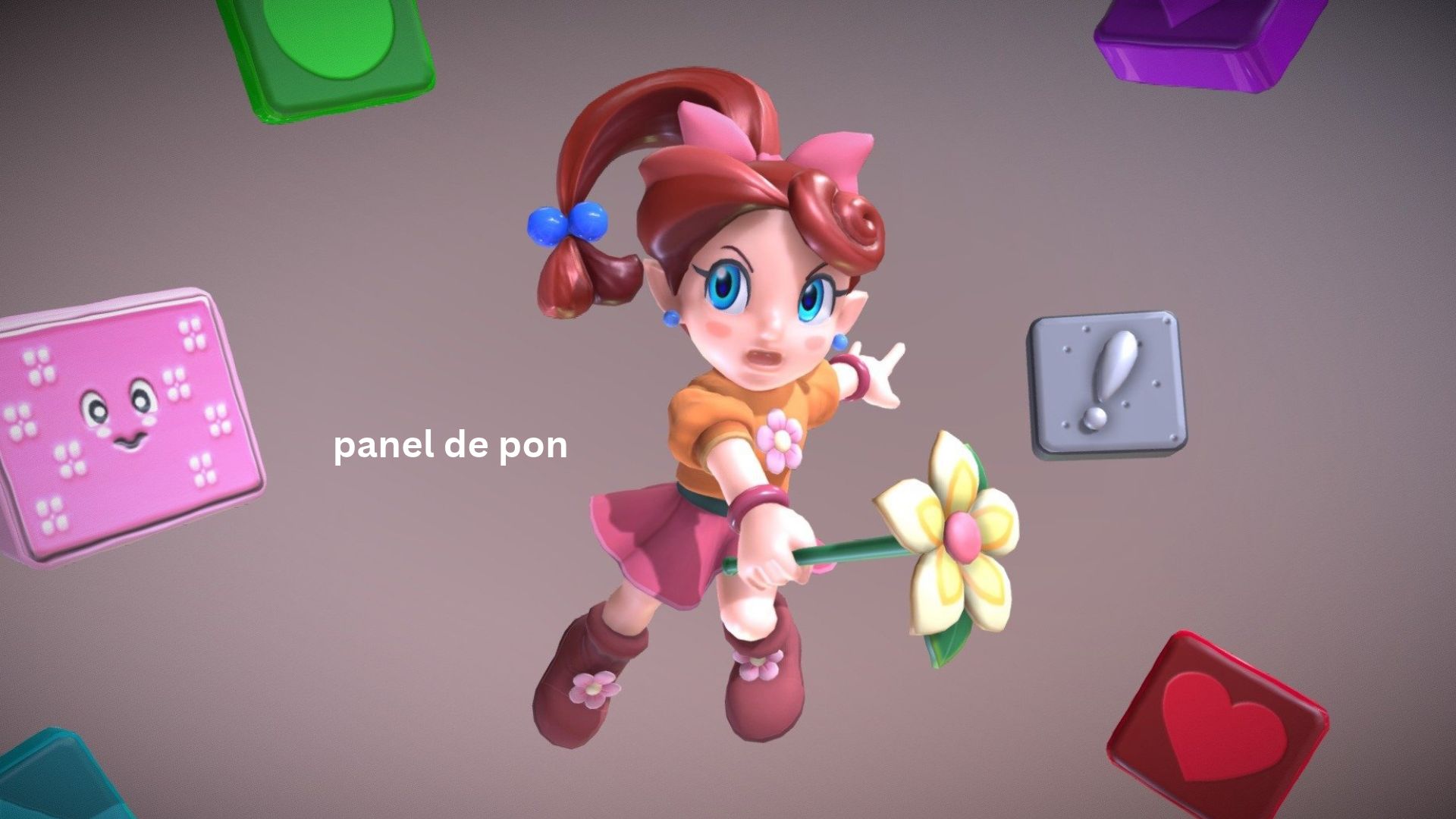
If you enjoy puzzle games but find yourself wanting something more active than simply dropping blocks into place, Panel de Pon is worth knowing. At first glance, it looks simple: colorful panels fill a board, you swap neighboring pieces, and matching three or more makes them disappear. The challenge becomes much deeper once the panels begin rising and every move affects what happens next.
Originally released in Japan for the Super Famicom in 1995, Panel de Pon became the foundation for the game known internationally as Tetris Attack. Despite the different name and characters used outside Japan, the underlying puzzle system remained largely the same. The game was developed by Intelligent Systems and published by Nintendo.
What makes Panel de Pon especially interesting is that it is not really about patiently finding the perfect match. You have to read the board, anticipate falling panels, create chains and react before the rising stack reaches the top. That combination of planning and reflexes gives the game a very different personality from many traditional match-three puzzles.
What Is Panel de Pon?
Panel de Pon is a tile-matching puzzle game in which players manipulate a continuously rising collection of colored panels.
The basic objective is straightforward:
- Move a cursor across the board.
- Swap two horizontally adjacent panels.
- Match three or more identical panels.
- Let those panels disappear.
- Use the resulting gaps and falling panels to create additional matches.
- Keep the stack from reaching the top of the playfield.
Nintendo’s original game description explains the central mechanic in essentially these terms: panels are rearranged by switching neighboring pieces, while groups of at least three identical panels disappear. The stack continuously rises, creating the pressure that makes each decision important.
That last point is critical. The rising board is what transforms a simple matching game into a real-time puzzle challenge.
You cannot simply stop and study the entire board indefinitely. Every second changes the situation.
The Origins of Panel de Pon
Panel de Pon was released in Japan on October 27, 1995, for the Super Famicom. The game was developed by Intelligent Systems, the company known for several important Nintendo titles, and was associated with Nintendo’s R&D efforts.
The original Japanese version has a fantasy setting centered on fairies, with Lip serving as the main character. This presentation is one of the major differences between Panel de Pon and the versions that Western players originally encountered.
Nintendo later adapted the game for international markets under the name Tetris Attack. Instead of using the original fairy characters and fantasy setting, the international version used characters and elements associated with Super Mario World 2: Yoshi’s Island.
This creates an interesting piece of video game history: many players who remember Tetris Attack were actually playing a localized version of Panel de Pon without realizing it.
And despite its name, Tetris Attack is not a traditional Tetris game. Its gameplay is based on Panel de Pon’s panel-swapping mechanics rather than falling tetrominoes.
How Panel de Pon Gameplay Works
The easiest way to understand Panel de Pon is to imagine a puzzle board that is constantly trying to overwhelm you.
Panels occupy spaces in a grid. You control a cursor covering two horizontal positions and can switch the panels in those positions.
Suppose you have:
Flower – Star – Star – Star – Moon
By moving the appropriate panels, you can create a group of three identical symbols. Once the match is formed, those panels disappear.
But the interesting part begins afterward.
Panels above the cleared spaces fall downward. If those falling panels create another match, the second group disappears as well.
This creates a chain.
Why chains matter
A simple three-panel match is useful, but a chain can be much more powerful.
For example:
- Match three panels.
- They disappear.
- Panels above them fall.
- The falling panels form another three-panel match.
- Those panels disappear.
- More pieces fall.
- A third match occurs.
Instead of making three separate moves, you have created several consecutive reactions from one initial action.
This is one of Panel de Pon’s most satisfying mechanics because the player is effectively setting up a puzzle in advance.
Panel de Pon Is More About Timing Than Matching
This is one of the most important things a new player can misunderstand.
A beginner often asks:
“Where is my next match?”
An experienced player is more likely to ask:
“What will happen after I make this match?”
That difference completely changes the way the game is played.
A good move can accomplish several things simultaneously:
- Clear dangerous panels.
- Create space.
- Prepare a future chain.
- Prevent the stack from reaching the top.
- Increase pressure on an opponent in versus play.
The best players therefore do not merely search for existing matches. They manipulate the board so that useful matches become available a few seconds later.
That forward-looking approach is one reason Panel de Pon has considerably more strategic depth than its colorful appearance initially suggests.
Why the Rising Stack Makes the Game Difficult
The rising panels are the game’s built-in timer.
In many traditional puzzle games, the player can spend a long time examining the board. Panel de Pon continually changes the situation.
As the stack rises, safe moves become less common.
This produces three levels of pressure:
1. Spatial pressure
You have fewer empty spaces available.
2. Time pressure
You cannot spend too long planning.
3. Cognitive pressure
You must simultaneously recognize matches, predict falling pieces and monitor the overall board.
This combination is what gives Panel de Pon its distinctive rhythm.
You are not simply solving a puzzle. You are solving a puzzle while the puzzle is becoming more dangerous.
Panel de Pon vs. Tetris Attack
The relationship between the two games is important for anyone researching the title.
| Feature | Panel de Pon | Tetris Attack |
|---|---|---|
| Original market | Japan | International markets |
| Original platform | Super Famicom | Super NES |
| Core mechanic | Swap adjacent panels | Swap adjacent panels |
| Original characters | Fairy-themed cast | Yoshi’s Island characters |
| Release era | 1995 | 1996 |
| Puzzle foundation | Panel de Pon | Panel de Pon adaptation |
The international release was not simply a completely different puzzle game. It was a localization and rebranding of the same fundamental design. Panel de Pon appeared in Japan in 1995, while Tetris Attack followed in North America and Europe in 1996.
There is also an important historical detail: the international title’s use of “Tetris” can be misleading. The gameplay does not involve the traditional falling tetromino system associated with Tetris. Even Henk Rogers, who was involved in licensing the Tetris name, later expressed regret that the name may have contributed to the game being overlooked historically.
The Importance of Combos and Chains
One of the biggest steps in improving at Panel de Pon is learning to distinguish matches from chains.
A match is something you create immediately.
A chain is something you prepare.
For example, imagine you notice that moving one panel creates a three-panel match. Before making the move, look at the panels above the potential match.
Ask:
- Which panels will fall?
- Will two identical panels land beside another matching panel?
- Could the next fall produce another match?
- Will the resulting chain create a useful position afterward?
This simple habit can dramatically improve your play.
A practical beginner technique
Do not try to create enormous chains immediately.
Instead, practice creating two-step chains.
Once that becomes comfortable, try three-step chains.
This teaches you to visualize falling panels without overwhelming you with complicated setups.
Playing Panel de Pon Against Another Player
Panel de Pon becomes particularly interesting when another player is involved.
Successful chains can affect the opponent’s board, creating additional obstacles and forcing them to respond.
This introduces a competitive layer that does not exist in ordinary single-player matching.
You are no longer asking only:
“Can I survive?”
You are also asking:
“Can I create enough pressure that my opponent cannot recover?”
This makes speed valuable, but speed alone is not enough.
A player who moves extremely quickly but creates weak matches may lose to someone who makes slower, more efficient chains.
That balance between speed and board awareness is one of the game’s most interesting competitive characteristics.
Common Mistakes Beginners Make
Trying to clear everything immediately
New players often clear every obvious match as soon as they see it.
That feels safe, but it can destroy opportunities for larger chains.
Sometimes leaving panels in place for a moment creates a better setup.
Ignoring the upper part of the board
Players naturally look at the panels near the cursor.
However, the most important information may be above the area they are currently manipulating.
Always think about what will fall after a match.
Moving too slowly
Planning is useful, but excessive hesitation can be fatal because the board continues rising.
You need to develop a balance between observation and action.
Chasing huge chains
Large chains look impressive, but attempting them constantly can be counterproductive.
A small, reliable chain that saves your board is often more valuable than an ambitious setup that takes too long.
Forgetting the board’s overall shape
A player can make several successful matches and still lose because the remaining stack has become difficult to manage.
Survival sometimes requires making a less exciting move simply to create space.
A Better Way to Learn Panel de Pon
If you are playing for the first time, do not immediately focus on advanced competitive techniques.
Use a progression like this:
Step 1: Learn the cursor
Become comfortable moving the cursor quickly and accurately.
Step 2: Learn basic matches
Practice creating groups of three without worrying about chains.
Step 3: Watch falling panels
After every match, deliberately observe where the remaining panels land.
Step 4: Create two-panel setups
Start arranging pieces so that a future match becomes possible.
Step 5: Practice short chains
Try to create two or three consecutive reactions.
Step 6: Increase speed gradually
Only after the mechanics become automatic should you focus heavily on faster play.
This approach is more effective than simply trying to play as quickly as possible from the beginning.
An Overlooked Skill: Creating Empty Space
One less obvious strategy is that empty space itself can be valuable.
A beginner tends to think about matching colors. An experienced player also thinks about the shape of the board.
Suppose the lower portion of your board is becoming crowded. You may have an opportunity to create a modest match that opens a vertical gap.
That gap can then allow several panels to fall.
The result may be strategically better than a larger immediate match that leaves the board crowded.
This is a useful perspective because Panel de Pon is not only a matching game. It is also a space-management game.
Another Overlooked Skill: Reading Gravity
The falling behavior of panels is central to advanced play.
Every time panels disappear, gravity changes the board.
Instead of seeing individual pieces, try to see columns and potential landing positions.
For example, if two matching panels are separated from a third by one space, you may be able to remove the panel underneath or beside them so that the pieces fall into alignment.
Once you start thinking this way, the board becomes less like a collection of random colored pieces and more like a predictable system.
That is a major step toward advanced play.
How Panel de Pon Influenced Later Puzzle Games
Panel de Pon became the foundation for a broader Puzzle League family.
Later adaptations included Pokémon-themed puzzle games, including Pokémon Puzzle Challenge and Pokémon Puzzle League, as well as Planet Puzzle League for Nintendo DS. A version also appeared as part of Nintendo Puzzle Collection on GameCube.
This is significant because the underlying gameplay proved flexible enough to support completely different characters and themes.
The formula could be dressed up as a fantasy game, a Yoshi game, a Pokémon game or a more general puzzle title without losing its fundamental appeal.
That is a strong indication that the mechanics themselves—not merely the characters—were responsible for the game’s longevity.
Where Can You Play Panel de Pon?
Panel de Pon originally appeared on the Super Famicom in Japan. It was subsequently rereleased on several Nintendo platforms, including Virtual Console releases and the Nintendo Classic Mini: Super Famicom.
One particularly important modern release occurred in 2020, when Panel de Pon was added to the Super Nintendo Entertainment System collection available through Nintendo Switch Online. This marked a major change in accessibility because the original Japanese title became available internationally rather than remaining primarily a Japanese release.
For someone discovering the game today, that historical availability matters. You do not necessarily need to search for the original cartridge to understand why the game developed such a dedicated following.
Is Panel de Pon Still Worth Playing?
Yes—especially if you enjoy puzzle games that reward improvement rather than simply completion.
Its biggest strength is that the basic rules can be understood within minutes, but mastering them takes substantially longer.
A new player can understand:
Match three panels.
An experienced player understands:
Create a match that produces a chain, opens the board, controls the stack, and creates pressure while preserving future options.
That difference between simple rules and complex mastery is a hallmark of good puzzle design.
Frequently Asked Questions
What is Panel de Pon?
Panel de Pon is a Nintendo puzzle game originally released for the Super Famicom in Japan in 1995. Players swap adjacent panels to create groups of three or more matching panels while the board continuously rises. The game later became internationally known through adaptations such as Tetris Attack.
Is Panel de Pon the same game as Tetris Attack?
At its core, yes. Tetris Attack was the international adaptation of Panel de Pon, with different characters, presentation and branding. The fundamental panel-swapping and chain-based puzzle mechanics remained intact.
Why is Panel de Pon difficult?
The game combines matching, spatial planning and real-time pressure. Because the stack continually rises, players cannot take unlimited time to examine the board. Advanced play also requires predicting how panels will fall after each match.
What is the best strategy for beginners in Panel de Pon?
Start by mastering basic three-panel matches and learning to watch what happens after panels disappear. Then practice short chains rather than immediately attempting complicated combinations. Most importantly, learn to manage empty space and avoid letting the rising stack become too tall.
Is Panel de Pon related to Tetris?
Panel de Pon and Tetris Attack are not traditional Tetris games. Although Tetris Attack used the Tetris name internationally, its gameplay is based on Panel de Pon’s panel-swapping system rather than falling tetrominoes.
Where did Panel de Pon first release?
The original Panel de Pon was released in Japan for the Super Famicom on October 27, 1995. It later received rereleases and eventually became available internationally through Nintendo’s Super Nintendo Entertainment System collection on Nintendo Switch Online.
Conclusion
Panel de Pon is easy to underestimate because its basic controls are so accessible. Yet beneath the colorful panels is a remarkably demanding puzzle system built around timing, prediction, spatial awareness and chain reactions.
Its history is equally fascinating. The 1995 Japanese Super Famicom game became Tetris Attack internationally, inspired later Puzzle League titles and eventually reached a much wider audience through Nintendo’s modern re-releases.
The best way to appreciate Panel de Pon is not to approach it simply as another match-three game. Think of it as a real-time puzzle where every match changes the geometry of the board and every second matters. Once you start planning around falling panels, preserving space and building chains deliberately, the seemingly simple game reveals the depth that has kept its design interesting for so many years.