

Kambal, Profiteering Mayor: Rules and Strategy
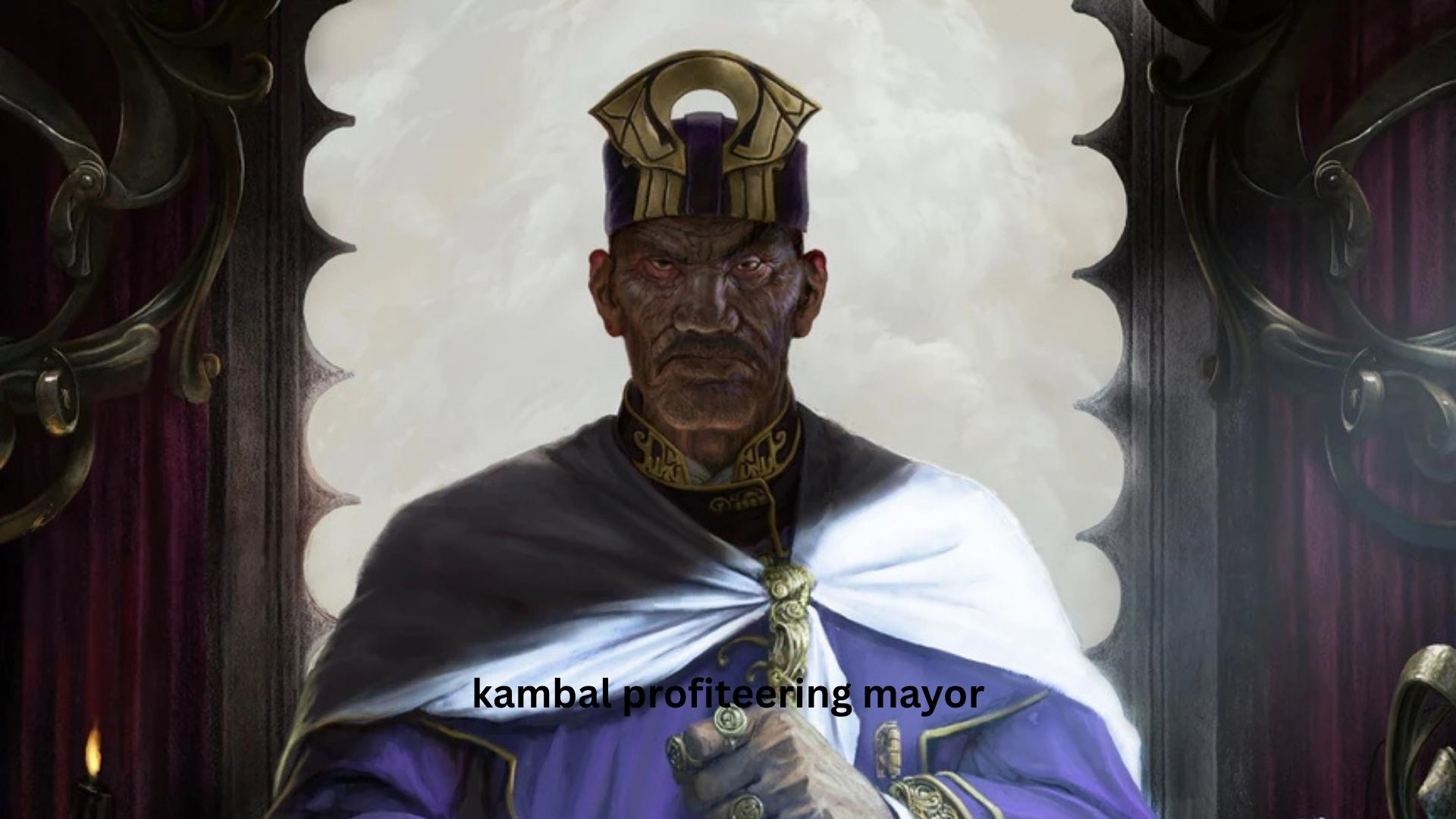
If you have ever played a Commander game where opponents suddenly create a pile of Treasure, Clues, Soldiers, Zombies, or other tokens, Kambal, Profiteering Mayor can turn that activity into an advantage surprisingly quickly. At first glance, Kambal looks like a simple token-copying creature with a small life-drain effect. In practice, however, understanding exactly when his abilities trigger is what makes the card powerful.
Kambal, Profiteering Mayor is a legendary 2/4 Human Advisor from Outlaws of Thunder Junction. He costs {1}{W}{B} and has two distinct triggered abilities. The first copies tokens created under opponents’ control, while the second rewards you whenever tokens enter under your control.
The important detail is that these abilities do not work exactly like many players initially assume. Kambal’s first ability triggers only once each turn, but when it resolves, it can create a copy for each qualifying token that entered. That difference matters enormously in Commander.
This guide explains how Kambal actually works, how to build around him, which interactions are easy to misunderstand, and how to get the most value from the card without relying on complicated rules tricks.
What Is Kambal, Profiteering Mayor?
Kambal, Profiteering Mayor is an Orzhov-colored legendary creature designed around token production, copying, and incremental life swings.
His two abilities are:
- Whenever one or more tokens enter under an opponent’s control, Kambal creates a tapped copy of each of those tokens.
- Whenever one or more tokens enter under your control, each opponent loses 1 life and you gain 1 life.
The first ability triggers only once per turn. The second ability does not contain that restriction.
That creates an interesting gameplay pattern.
You are not simply stealing your opponent’s tokens. Instead, Kambal effectively says: if your opponent is producing tokens, I can benefit from that production too.
This makes him particularly attractive in Commander, where multiple players routinely create tokens during the same game.
How Kambal’s First Ability Really Works
The most important phrase to understand is “for each of them.”
Suppose an opponent creates five Treasure tokens at the same time.
If Kambal has not triggered earlier that turn, his first ability triggers once. When that ability resolves, Kambal creates five tapped Treasure tokens.
He does not trigger five separate times.
This distinction is one of the most common sources of confusion when playing the card. Community rules discussions have repeatedly highlighted that Kambal’s “once each turn” restriction applies to the trigger itself, while the resolving ability can still create multiple copies.
Example: Five Treasure tokens
Imagine your opponent resolves an effect that creates five Treasure tokens.
The sequence is:
- The five Treasures enter under your opponent’s control.
- Kambal sees the tokens.
- His first ability triggers once.
- The trigger resolves.
- You create five tapped Treasure tokens that copy the appropriate tokens.
- Those five tokens enter under your control.
- Kambal’s second ability triggers.
- Each opponent loses 1 life and you gain 1 life.
The key lesson is simple: one trigger does not necessarily mean one token.
Does Kambal Copy Tokens Exactly?
Not completely.
Kambal copies the characteristics of the token as defined by the effect that created it. He does not simply reproduce every physical or temporary property of the original token. Wizards’ release notes specifically clarify that the copy does not copy whether the original token is tapped or untapped, counters on it, Auras, Equipment, or other non-copy effects that modified it.
This creates a practical distinction between copyable characteristics and current game-state modifications.
For example, if an opponent controls a 1/1 token that received three +1/+1 counters, Kambal’s copy does not automatically enter with those counters.
Likewise, if the original token has been modified by an effect that changes its power or toughness, those temporary modifications generally are not copied.
What happens if the token is already a copy?
This is another important interaction.
If the opponent’s token is itself copying another permanent, Kambal’s new token copies what that token is copying. The official release notes confirm this behavior.
This means Kambal can become much more interesting in decks where opponents are already using copy effects.
Why the “Once Each Turn” Clause Matters
Kambal’s first ability says it triggers only once each turn.
This is a significant limitation, especially in multiplayer games.
Suppose an opponent creates one Treasure early in the turn. Kambal triggers.
Later, another opponent creates ten Soldier tokens.
Kambal’s first ability will not trigger again that turn because its once-per-turn trigger has already happened.
This is why timing matters.
A common mistake is to assume that Kambal copies every batch of opponent tokens throughout the turn. He does not.
A useful way to think about it
Think of Kambal’s first ability as a once-per-turn token tax rather than a permanent token-copying engine.
The first qualifying token event gets his attention.
After that, the first ability is effectively switched off until the next turn.
This makes the timing of removal, token production, and combat decisions surprisingly important.
Kambal’s Second Ability Is Different
Kambal’s second ability works differently:
Whenever one or more tokens enter under your control, each opponent loses 1 life and you gain 1 life.
There is no “once each turn” restriction on this ability.
That means Kambal can repeatedly generate life swings when you create tokens.
Suppose you create tokens in three separate events during your turn.
Kambal can trigger three times.
If you are playing a four-player Commander game, each trigger causes each opponent to lose 1 life, while you gain 1 life.
That can add up over several turns even when the individual triggers look small.
The Most Important Kambal Interaction: Copying Creates More Triggers
One of the cleverest aspects of Kambal is that his two abilities can interact with each other.
His first ability creates tokens under your control.
Those tokens entering the battlefield then satisfy the condition for his second ability.
So an opponent’s token production can create a chain like this:
Opponent creates tokens → Kambal copies them → your copies enter → opponents lose life → you gain life.
This is why Kambal can generate value even when you are not the player initiating the token strategy.
A five-token event, for example, can simultaneously increase your board presence and produce a life swing.
Kambal in a Four-Player Commander Game
Kambal becomes especially interesting in multiplayer because the phrase “your opponents” refers to the players who are opponents of you.
Consider a four-player game.
If an effect causes each opponent to create three tokens, Kambal can potentially create copies corresponding to the tokens entering under your opponents’ control, provided his first ability has not already triggered that turn.
The resulting token count can therefore become much larger than a casual reading of the card might suggest.
A real rules discussion involving Alliance of Arms illustrates this type of interaction: when multiple opponents create tokens simultaneously, Kambal’s ability can account for the tokens entering under opponents’ control, rather than merely copying one token.
This is one reason Kambal has more multiplayer potential than his modest 2/4 body initially suggests.
Does Kambal Trigger for Tokens You Create?
Yes, but the two abilities do different jobs.
When you create your own tokens, the first ability does nothing because it specifically watches tokens entering under opponents’ control.
The second ability does trigger because it watches tokens entering under your control.
For example, if you create four Soldier tokens:
- Kambal’s first ability does not trigger.
- His second ability triggers once for that token-entry event.
- Each opponent loses 1 life.
- You gain 1 life.
The number of tokens does not multiply the life-drain trigger in this example.
Four tokens entering simultaneously still represent one or more tokens entering, so the second ability triggers once for that event.
That distinction is another important rules point.
A Common Mistake: Counting Tokens Instead of Events
Players frequently count the number of tokens rather than asking how many separate token-entry events occurred?
Those are not always the same thing.
Imagine an effect creates five tokens simultaneously.
That is generally one event involving five tokens.
Kambal’s second ability triggers once.
Now imagine five different effects each cause a token to enter separately.
Those can produce five separate token-entry events, potentially resulting in five triggers.
This event-based way of thinking is much more reliable when resolving Kambal interactions.
What Happens If Kambal Dies After Triggering?
This is an especially useful situation to understand.
Suppose an opponent creates tokens and Kambal’s first ability triggers. Before that triggered ability resolves, Kambal is destroyed.
The ability can still resolve.
Triggered abilities exist independently of their source once they are on the stack. A rules discussion involving Martial Coup demonstrates this practical point: Kambal can see tokens enter, have his ability trigger, and then still create copies after Kambal himself has died.
However, there is an important difference.
If the copied tokens enter after Kambal is already gone, his second ability cannot trigger from those new tokens because Kambal is no longer on the battlefield.
So:
Kambal can finish an already-triggered first ability after dying, but he cannot trigger a new ability while he is absent.
That distinction is easy to miss during a complicated board wipe.
What If Kambal Loses His Abilities?
Another advanced interaction involves effects that remove Kambal’s abilities.
If Kambal loses his abilities before the token-entry event occurs, he cannot trigger from that event.
A rules discussion involving Amphibian Downpour illustrates why the timing matters: if Kambal has already become a Frog and lost his abilities when the tokens enter, his abilities do not trigger for that event.
The practical lesson is:
Look at Kambal’s characteristics immediately after the event.
Do not assume that because he was on the battlefield a moment earlier, his triggered ability automatically applies.
Which Tokens Are Best With Kambal?
Kambal is naturally strongest when opponents are already creating useful tokens.
Some particularly valuable token types include:
- Treasure — provides additional mana.
- Clues — provides card-draw potential.
- Food — provides life and can support sacrifice strategies.
- Creature tokens — increase your board presence.
- Tokens with enter-the-battlefield abilities — can create additional value.
- Tokens that are copies of powerful permanents — can become especially interesting because Kambal copies their relevant characteristics.
The best scenario is not necessarily the token with the highest power.
Instead, look for tokens that provide resources, repeatable value, sacrifice material, or useful triggered abilities.
Kambal and Token-Based Commander Decks
Kambal can be built as a dedicated Commander or used as part of a broader Orzhov token strategy.
A strong deck around him usually wants several overlapping themes:
1. Token production
You want reliable ways to create tokens yourself so that the second ability keeps generating life swings.
2. Token copying
Cards that create additional tokens can increase the number of permanents available for sacrifice, combat, or other effects.
3. Sacrifice outlets
Tokens are temporary resources. Sacrifice outlets allow you to turn them into cards, mana, life, or other effects before they disappear.
4. Life-drain payoffs
Because Kambal naturally creates repeated life-loss events, effects that reward opponents losing life can strengthen the strategy.
5. Protection
Kambal is only a 2/4 creature. In Commander, opponents have many ways to remove creatures, so protecting him can be more valuable than simply adding another token-maker.
A Less Obvious Strategy: Let Opponents Do the Work
One of the most interesting ways to build around Kambal is not to become obsessed with making your own tokens.
Instead, exploit what opponents are already doing.
This is particularly effective in casual Commander games where Treasure, Clues, Food, creature tokens, and other resources appear naturally.
Kambal can therefore function as a form of reactive value engine.
You do not necessarily need to convince opponents to cooperate. You simply benefit when their normal game plan involves token production.
That makes Kambal different from a traditional go-wide token commander.
Another Overlooked Point: Kambal Rewards Politics
Kambal can also create unusual political incentives.
An opponent may want to produce ten tokens because those tokens advance their strategy. Kambal’s controller benefits too.
This creates an interesting dynamic: you can sometimes allow an opponent’s engine to develop rather than immediately removing it, because their token production is indirectly generating resources for you.
Of course, this should not become an excuse to ignore a dangerous combo.
The practical decision is to compare:
How much value will Kambal generate from the opponent’s tokens?
against:
How dangerous is the opponent’s token engine if left alone?
That is a more useful way to evaluate Kambal than simply counting the number of tokens he can copy.
Common Mistakes When Playing Kambal
Here are the mistakes worth checking before calling a judge or arguing about a board state:
- Assuming the first ability triggers once per token.
It triggers once per qualifying token-entry event, not once for every token. - Forgetting “for each of them.”
One trigger can create multiple tokens. - Assuming counters are copied.
Counters, Auras, Equipment, and many non-copy modifications are not part of the copied characteristics. - Forgetting the once-per-turn restriction.
Kambal’s first ability cannot trigger repeatedly throughout the same turn. - Treating the second ability as once per turn.
It is not. - Assuming Kambal must still be alive for an existing trigger to resolve.
Once the ability is on the stack, it can generally resolve independently of its source. - Counting tokens instead of token-entry events.
Five tokens entering simultaneously are not automatically five separate triggers.
Is Kambal, Profiteering Mayor Good?
Kambal is strongest when the surrounding game naturally contains lots of tokens.
He offers three valuable things at once:
- Additional board presence.
- Repeated life swings.
- The ability to benefit from opponents’ token strategies.
His biggest weakness is also clear: the first ability is restricted to once each turn, and Kambal himself is vulnerable to creature removal.
Therefore, Kambal is not automatically powerful in every Commander environment.
He becomes much more attractive when:
- Several players use token strategies.
- Treasure production is common.
- Your deck has token payoffs.
- You can protect or recur Kambal.
- You can exploit repeated life-loss triggers.
- You have ways to turn excess tokens into additional resources.
Final Verdict
Kambal, Profiteering Mayor is a card that rewards careful rules knowledge more than a quick reading of its text suggests.
The most important concept is that Kambal’s first ability triggers only once each turn, but that single trigger can copy every qualifying token from the event that caused it. His second ability then rewards you when those copies enter under your control.
For practical gameplay, think in terms of events, not individual tokens. Ask what created the tokens, whether they entered simultaneously, whether Kambal has already triggered this turn, and which characteristics are actually copyable.
The deeper appeal of Kambal is that he does not require every advantage to come from your own cards. In a multiplayer game, opponents’ token engines can become part of your value engine too.
That makes him particularly interesting for players who enjoy Orzhov strategies, political Commander games, token decks, and cards whose strongest interactions emerge from precise rules timing.
FAQ
How does Kambal, Profiteering Mayor work?
Kambal has two token-related triggered abilities. His first copies tokens that enter under opponents’ control, but it can trigger only once each turn. His second triggers whenever one or more tokens enter under your control, causing each opponent to lose 1 life while you gain 1 life.
Does Kambal copy every token an opponent creates?
Not necessarily every token throughout the turn. His first ability triggers only once each turn, but when that trigger resolves, it creates a tapped copy for each token involved in the qualifying event. Therefore, a single event creating five tokens can result in five Kambal copies.
Does Kambal copy counters or Equipment?
No. Kambal copies the appropriate characteristics of the token, but counters, Auras, Equipment, and many non-copy effects modifying the original token are not copied. Wizards’ release notes specifically clarify these distinctions.
Does Kambal’s second ability trigger once for five tokens?
If five tokens enter simultaneously under your control, the second ability normally triggers once because it watches for “one or more tokens” entering. If the tokens enter through separate events, the ability can trigger separately for those events. This event-based distinction is essential when resolving complicated token combinations.
What happens if Kambal dies after his first ability triggers?
The triggered ability can generally remain on the stack and resolve even if Kambal has left the battlefield. He can therefore still create the copies from an already-resolved trigger. However, if Kambal is gone when those new tokens enter, he cannot trigger his second ability from their arrival.
Is Kambal, Profiteering Mayor good in Commander?
Kambal can be very effective in Commander, especially when several players create tokens. He is particularly interesting in multiplayer because opponents’ Treasure, Clue, Food, and creature-token production can generate value for him. His once-per-turn first ability prevents unlimited copying, so his effectiveness depends heavily on timing, deck construction, and the surrounding metagame.
Conclusion
Kambal, Profiteering Mayor looks straightforward, but his real strength comes from the details.
The most important rules are simple once you break them down: his first ability triggers only once per turn, one trigger can copy multiple tokens, his second ability rewards your own token entries, and copied tokens do not inherit every temporary modification from the originals.
For players building around Kambal, the best approach is to think beyond “make lots of tokens.” Look for ways to turn token events into mana, cards, life swings, sacrifice value, and political leverage.
That is where Kambal becomes more than a token-copying creature. He becomes a flexible engine that can profit from what everyone at the Commander table is already doing.